



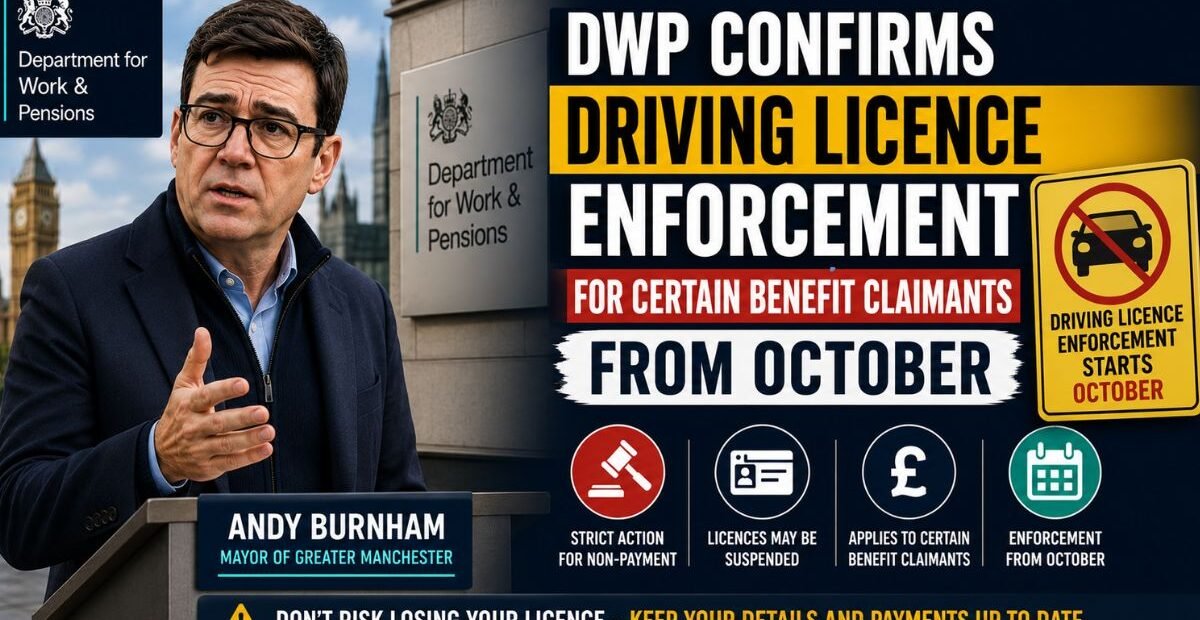
DWP Confirms Driving Licence Enforcement for Certain Benefit Claimants From October

The Department for Work and Pensions (DWP) is set to receive stronger powers to recover unpaid benefit-related debts, including the ability to seek driving disqualifications lasting up to two years in certain cases.
The measures form part of the Public Authorities (Fraud, Error and Recovery) Act 2025, introduced as part of the UK Government’s wider effort to tackle benefit fraud, incorrect payments and outstanding welfare debt.
From October 2026, new recovery measures will begin rolling out, including powers that can allow money to be taken directly from certain bank accounts where debts remain unpaid.
When Could the DWP Seek a Driving Ban?
The legislation makes clear that driving disqualification is intended as a last-resort enforcement measure.
The DWP can only consider seeking a driving disqualification when the outstanding debt is at least £1,000 and recovering the money through other reasonable methods has not been possible.
The measures are primarily aimed at people who owe money following fraudulent benefit claims or who repeatedly fail to repay debts despite having the financial ability to do so.
Universal Credit, Pension Credit and Employment and Support Allowance (ESA) are among the benefits identified as having significant levels of fraud.
People Currently Receiving DWP Benefits Are Protected
Under the legislation, the DWP cannot use its driving disqualification powers against someone who, when the application is made, is entitled to and currently receiving a DWP benefit.
Before imposing a disqualification, a court must also determine that the person:
- Had sufficient means to repay the money owed;
- Failed to make repayments without a reasonable excuse; and
- Does not have an essential requirement to drive.
Where driving is necessary to earn a living or fulfil important responsibilities, the court cannot impose the ban. This could include people whose employment depends on driving, such as couriers, or those who need a vehicle because of caring responsibilities.
The affected individual must explain any essential need for their licence to the court.
How Claimants Can Avoid Losing Their Licence
People with outstanding DWP debts can prevent further enforcement action by either repaying the amount in full or agreeing to an affordable repayment plan with the department and keeping up with those payments.
Driving bans are initially suspended while agreed repayment arrangements continue to be followed.
This gives debtors an opportunity to resolve what they owe before losing their licence.
The 56-Day Rule Explained
The legislation also contains rules covering how licences are returned following an immediate disqualification order.
Where an immediate driving disqualification is revoked or ends within 56 days because the person has fully repaid their debt, they may qualify to have their licence returned or replaced by the DVLA without paying a fee.
However, if the disqualification lasts longer than 56 days, the person will normally need to apply to the DVLA for a renewed driving licence and pay the applicable fee.
Maximum Driving Ban Is Two Years Per Order
An individual immediate disqualification order cannot last for more than two years.
However, the DWP has explained that more than one order could potentially be issued where someone repeatedly breaches suspended repayment arrangements without reasonable justification.
As a result, separate orders could lead to the person’s total period without a licence exceeding two years.
Once the outstanding debt has been fully repaid, the DWP must apply for an immediate disqualification order to be revoked. The department will inform the court that payment has been completed, after which the court can notify the DVLA that the order has ended.
DWP Can Recover Money From Bank Accounts
The new legislation also strengthens the department’s ability to recover money from individuals who are no longer receiving benefits or earning through PAYE employment.
From October 2026, officials will begin receiving powers enabling money owed to the DWP to be recovered directly from certain bank accounts without first obtaining a court order.
Previously, the department had fewer options when pursuing individuals who had stopped receiving benefits or were outside PAYE employment, even where they had the means to repay outstanding debts.
Driving disqualification remains one of the strongest measures and requires an application to a court.
Government Expects Billions in Fraud and Debt Savings
The Government says the expanded recovery programme could help the DWP secure up to £1.5 billion over the next five years.
Work and Pensions Minister for Transformation Andrew Western said the measures are intended to pursue people who deliberately avoid paying debts while continuing to offer affordable repayment arrangements to those who engage with the DWP.
Minister Satvir Kaur also said that public-sector fraud and unpaid debts reduce the funding available for essential frontline services and that the new legislation is designed to better protect taxpayers.
The wider Government programme aims to achieve approximately £14.6 billion in savings over five years by reducing fraud, error and debt.
Plans also include investment in as many as 3,000 additional staff, together with stronger data analysis and investigative capabilities.
Further Eligibility Checks Are Planned
Another measure contained in the legislation is the Eligibility Verification Measure, which is expected to take effect at a later stage.
It will allow the DWP to request limited information from banks and other financial institutions to help identify potentially incorrect benefit payments.
The Government says this will make it easier to identify discrepancies quickly while helping ensure claimants receive the correct amount of benefit.
DWP Urges People With Debts to Act Before October 2026
Letters are already being sent to some individuals with outstanding DWP debts asking them to arrange payment.
People who are no longer receiving benefits but still owe money are being encouraged to respond to correspondence and contact the DWP rather than ignoring repayment requests.
The new enforcement powers are expected to be introduced gradually beginning in October 2026, giving affected individuals an opportunity to clear their debts or arrange an affordable repayment plan before stronger measures are considered.
The DWP’s new debt recovery powers represent a significant tightening of enforcement against people who can afford to repay benefit-related debts but repeatedly fail to do so.
Driving bans of up to two years will be available in serious cases involving debts of at least £1,000, although courts must consider whether the person has an essential need to drive.
For anyone receiving DWP debt correspondence, arranging repayment or agreeing to an affordable payment plan before the new measures are fully introduced could prevent stronger enforcement action.