


Hoekstra Says Canadians View U.S. Unfavorably as Trump Threatens New Tariffs

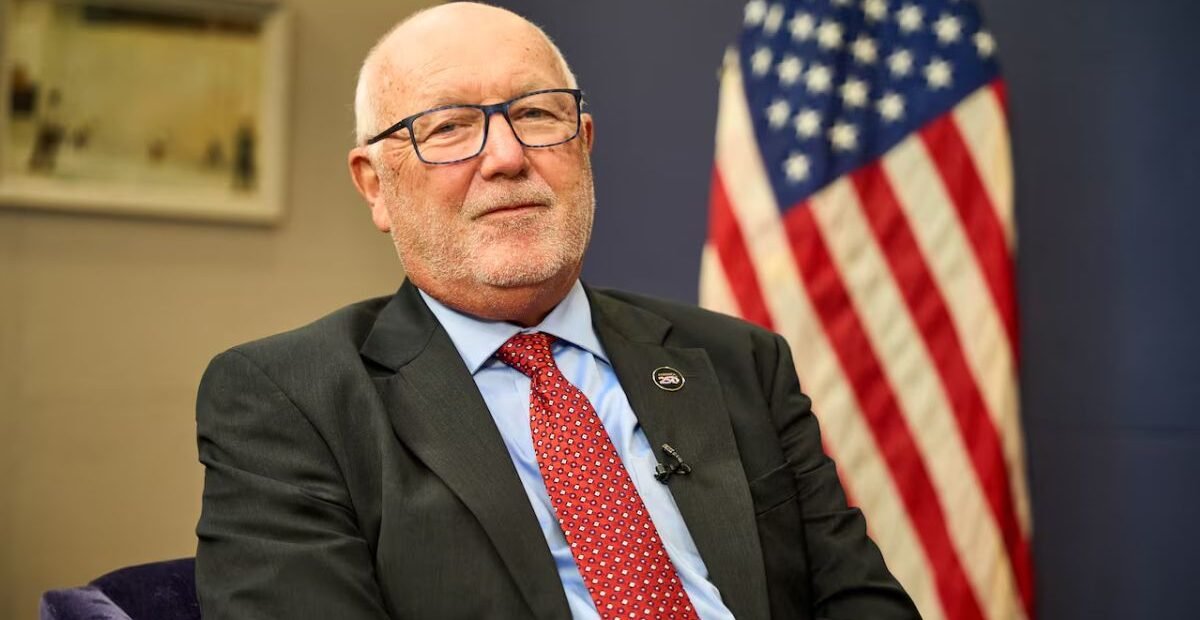
U.S. Ambassador to Canada Pete Hoekstra has acknowledged that worsening public opinion of the United States among Canadians is creating additional challenges for political leaders attempting to reach a new trade agreement.
Hoekstra made the remarks during a fireside discussion at the Pacific Northwest Economic Forum in Edmonton, where Canada–U.S. trade relations, tariffs and future economic cooperation were major topics.
Hoekstra Toasts Canada–U.S. Relations
Before addressing a room filled with business and political representatives, Hoekstra raised a plastic shot glass containing an unidentified spirit.
Although it was still before 10 a.m. on Monday, the ambassador described the toast as part of a new tradition at economic forums. He referred to the drink as either Canadian “whisky” or American “whiskey,” but did not identify it more precisely.
At an earlier conference in Regina, Hoekstra and other attendees drank bourbon. However, the American corn-based spirit has become harder to find in Canada because of widespread boycotts connected to the trade dispute, U.S. tariffs and previous annexation threats.
During his toast, Hoekstra emphasized the importance of strengthening and stabilizing the relationship between the two countries. He argued that a stronger partnership could create a prosperous future for both Canadians and Americans.
Ambassador Highlights Opportunities for Future Cooperation
Throughout the discussion, Hoekstra repeatedly pointed to the unrealized potential of the Canada–U.S. partnership.
He identified artificial intelligence, space technology and nuclear energy as emerging sectors in which the neighbouring countries could cooperate more closely in the future.
However, that optimistic vision contrasts with the current uncertainty surrounding negotiations over the Canada–United States–Mexico Agreement, commonly known as CUSMA.
United States Declines Long-Term CUSMA Renewal
July 1 was the deadline for Canada, the United States and Mexico to indicate whether they supported renewing CUSMA for another 16 years.
Canada and Mexico expressed support for extending the agreement. Canadian Trade Minister Dominic LeBlanc confirmed Canada’s intention to renew it, while Mexican officials communicated a similar position.
The United States was the only country that chose not to approve the long-term renewal. As a result, the agreement has entered an annual review process that could continue for the next decade.
Hoekstra said Mexico and the United States were already in their third round of detailed discussions and were making progress on resolving individual issues.
He also warned that uncertainty surrounding Canadian negotiations with Washington was encouraging businesses and investment to move south of the border.
Canadian Opinion Complicates Trade Talks
Hoekstra told the Edmonton audience that reaching an agreement would require a different approach and greater certainty.
He admitted that many Canadians currently hold an unfavourable view of the United States. According to the ambassador, this negative public sentiment makes it more difficult for politicians to negotiate and approve an agreement.
Hoekstra argued that people on both sides of the border should speak more frequently about the importance of bilateral trade to economic, national and personal security.
Poll Shows Falling Trust in the United States
Recent polling indicates that Canadian confidence in the United States as a trading partner has declined sharply.
Only 35 per cent of Canadians now consider the U.S. a reliable trade partner. A comparable survey conducted in 2022 found that 83 per cent held that view.
The decline reflects growing anger over tariffs and their effects on Canadian communities and workers.
Residents of Coaticook, Quebec, recently described increasing hostility toward their American neighbours. Approximately 200 employees at a local plant lost their jobs after tariffs imposed by U.S. President Donald Trump affected the wood-products industry.
Canadian wood products have not received the same protections that apply to many Canadian goods affected by U.S. automotive tariffs.
Wildfire Smoke Tariff Suggestion Creates Further Anger
Trump added to the tension by suggesting that Canada should face tariffs because wildfire smoke was drifting into the United States.
The comments came as more than 900 active wildfires were burning across Canadian forests and communities.
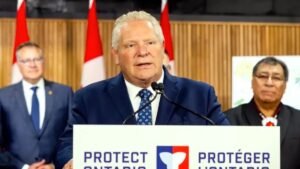
Ontario Premier Doug Ford rejected the suggestion and called on the U.S. president to provide assistance instead of complaining.
Ford said the United States could send water bombers or wildland firefighters to support Canadian firefighting efforts. He also noted that thousands of fires were burning in the United States, yet Canada was not blaming or criticizing its neighbour.
Hoekstra continues to promote the long-term economic potential of cooperation between Canada and the United States. However, tariffs, investment uncertainty and declining Canadian trust are making trade negotiations increasingly difficult.
Rebuilding public confidence may become essential if both governments hope to stabilize their relationship, secure CUSMA’s future and expand cooperation in industries such as artificial intelligence, space technology and nuclear energy.