


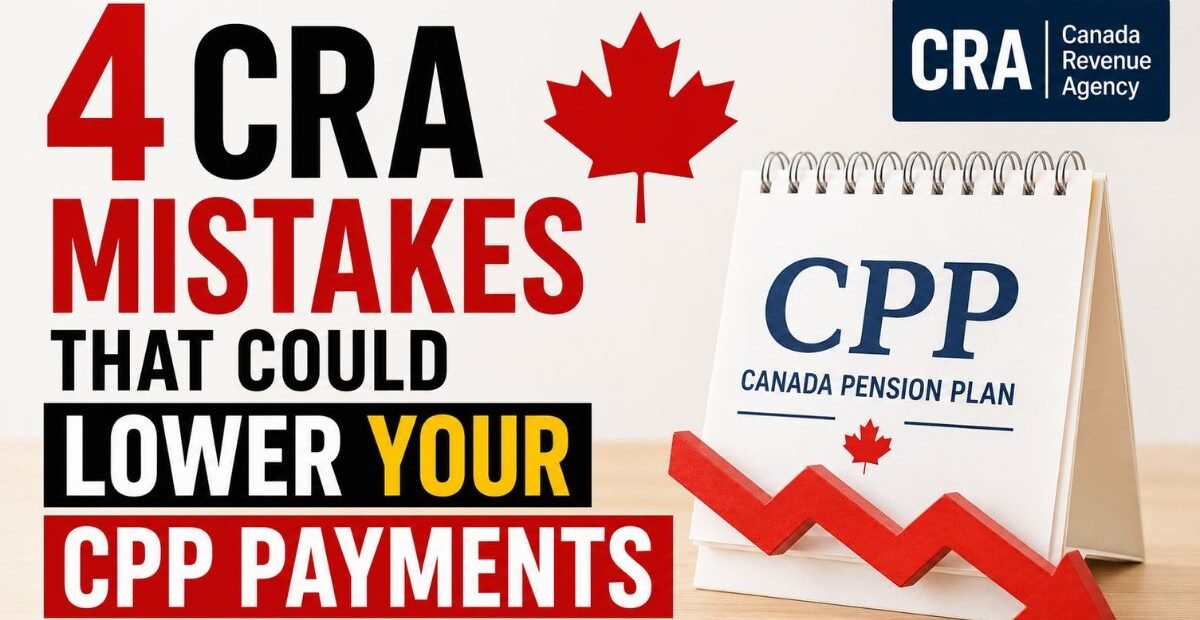
4 CRA Mistakes That Could Lower Your CPP Payments

Many Canadians expect the Canada Pension Plan (CPP) to provide a substantial portion of their retirement income, but the amount actually received can be much lower than the maximum.
In 2026, the maximum CPP retirement pension for someone starting benefits at age 65 is $1,507.65 per month, while the average payment for new beneficiaries is approximately $877.01 per month. A worker’s earnings history, CPP contributions, and the age at which benefits begin are major reasons for this difference.
However, several tax and contribution issues can reduce the amount retirees ultimately have available to spend.
1. Your CPP Benefit and Your Bank Deposit Are Not Always the Same
CPP retirement benefits generally are not reduced simply because a retiree has a high income. Income-based recovery rules are primarily associated with Old Age Security (OAS) rather than CPP.
CPP payments are, however, considered taxable income. In addition, outstanding federal debts may affect how much money actually reaches a retiree’s bank account.
Information maintained by the Canada Revenue Agency (CRA) about earnings and CPP contributions is also used by Service Canada when calculating benefits.
As a result, problems may appear through:
- A lower net CPP deposit
- A larger income tax bill
- Errors in a person’s CPP contribution record
2. Not Having Enough Tax Withheld From CPP
Federal income tax is not automatically deducted from CPP payments unless the recipient requests withholding.
This can become a problem for retirees receiving income from several sources, such as:
- CPP
- A workplace pension
- Registered Retirement Income Fund (RRIF) withdrawals
Each payer may calculate withholding without knowing the retiree’s total annual income. Consequently, insufficient tax may be collected during the year, potentially resulting in a significant balance owing when the tax return is filed.
Retirees can request voluntary federal income tax deductions from their CPP through My Service Canada Account. The withholding amount should also be reviewed whenever other retirement income changes.
3. Outstanding CRA Debt Can Affect CPP Payments
Unpaid CRA debts should not be ignored.
The CRA may request that money otherwise payable by the federal government, potentially including CPP or OAS payments, be applied toward an outstanding debt.
Having a repayment arrangement does not necessarily guarantee that every government payment will be protected from a set-off.
Retirees experiencing difficulty paying CRA debt should contact the agency early and discuss an affordable repayment arrangement before additional collection measures occur.
4. Filing CPT30 Can Reduce Future Retirement Benefits
Canadians who continue working while receiving CPP generally continue making CPP contributions before age 65.
Between ages 65 and 70, eligible employees can choose to stop contributing by completing Form CPT30 and providing it to both their employer and the CRA.
Stopping CPP contributions can increase current take-home pay, but there is an important trade-off: the worker will no longer accumulate additional Post-Retirement Benefits (PRBs) from those contributions.
In 2026, one year of maximum CPP contributions can generate as much as $54.69 per month in additional lifetime retirement income. The benefit is also indexed.
Stopping contributions may still make sense for someone who requires additional cash immediately, particularly self-employed individuals who effectively pay both the employee and employer portions. However, the long-term value of the lost PRB should be considered carefully before making the decision.
Check Your CPP Contribution Record
The CRA provides earnings and contribution information to Service Canada, where it appears on the CPP Statement of Contributions.
Errors such as missing employment income, incorrect T4 information, or an unfiled self-employment tax return could affect future CPP retirement benefits or Post-Retirement Benefits.
Canadians should periodically compare their CPP contribution history with previous:
- T4 slips
- Employment records
- Income tax returns
Incorrect or missing information should be addressed as soon as possible, preferably well before retirement.
Using a TFSA to Supplement CPP Income
CPP does not necessarily need to cover every retirement expense.
A Tax-Free Savings Account (TFSA) can provide another source of retirement income. Eligible investment income and withdrawals from a TFSA are generally tax-free and do not increase taxable income, provided contribution rules are followed.
For some retirees, dividend-paying Canadian stocks may therefore help supplement CPP and other government benefits.
Fortis as a Dividend Example
Fortis (TSX: FTS) operates regulated electric and natural gas utilities serving approximately 3.5 million customers across Canada, the United States, and the Caribbean.
Its regulated utility operations provide relatively predictable revenue because approved rates help finance essential infrastructure.
Fortis reported second-quarter earnings of $0.78 per share and has a $28.8 billion capital investment plan expected to support roughly 7% annual rate-base growth through 2030.
Management is targeting annual dividend growth of approximately 4% to 6% through 2030, following 52 consecutive years of dividend increases.
At a share price of $77.23, its annual dividend of $2.56 per share represents a yield of about 3.3%. The stock trades at roughly 23 times trailing earnings.
Investors should still consider risks including interest rates, regulatory decisions, construction expenses, debt levels, and valuation. Dividend stability does not eliminate investment risk.
CPP retirement income can be affected by more than simply contribution history. Canadians approaching or already in retirement should review their CPP contribution records, consider voluntary tax withholding, deal with CRA debts promptly, and carefully evaluate the consequences of stopping CPP contributions after age 65.
For those with available TFSA contribution room, investments such as dividend-paying Canadian stocks may provide an additional tax-free income stream and reduce reliance on CPP alone.