



Meteorite That Crashed Through A House May Hold Clues to Life’s Origins

A meteorite that crashed through the roof of a home in Hillsborough, New Jersey, has given scientists a rare and unusually clean sample of ancient asteroid material.
Researchers say the space rock contains organic compounds, amino acids and evidence of salty fluids, making it important for understanding how the chemical building blocks of life may have reached early Earth.
Meteorite Crashed Into Bedroom After Sonic Boom
On July 16, 2024, a daytime meteor created a sonic boom over the New York City region as it passed near the Statue of Liberty and moved across the northeastern United States.
The object entered Earth’s atmosphere at about 32,000 miles per hour, or 14.4 kilometres per second, before breaking apart. A fragment weighing more than two pounds later smashed through the roof and ceiling of a home in Hillsborough, landing in a bedroom.
Homeowner Preserved the Fragments Carefully
The homeowner found black fragments, dust and debris in the room, along with a strong sulfur-like smell.
In an unusually helpful move for science, the homeowner used disposable gloves, aluminum foil and glass jars to collect and preserve the pieces. Researchers said that quick action prevented much of the contamination that commonly affects recovered meteorites.
Why the Clean Recovery Matters
The meteorite belonged to a fragile carbon-rich class that can easily absorb moisture and contamination from Earth.
Because the homeowner avoided touching the fragments with bare hands, scientists were able to examine delicate minerals and organic compounds in a much more pristine state than usual.
Named the Hillsborough Meteorite
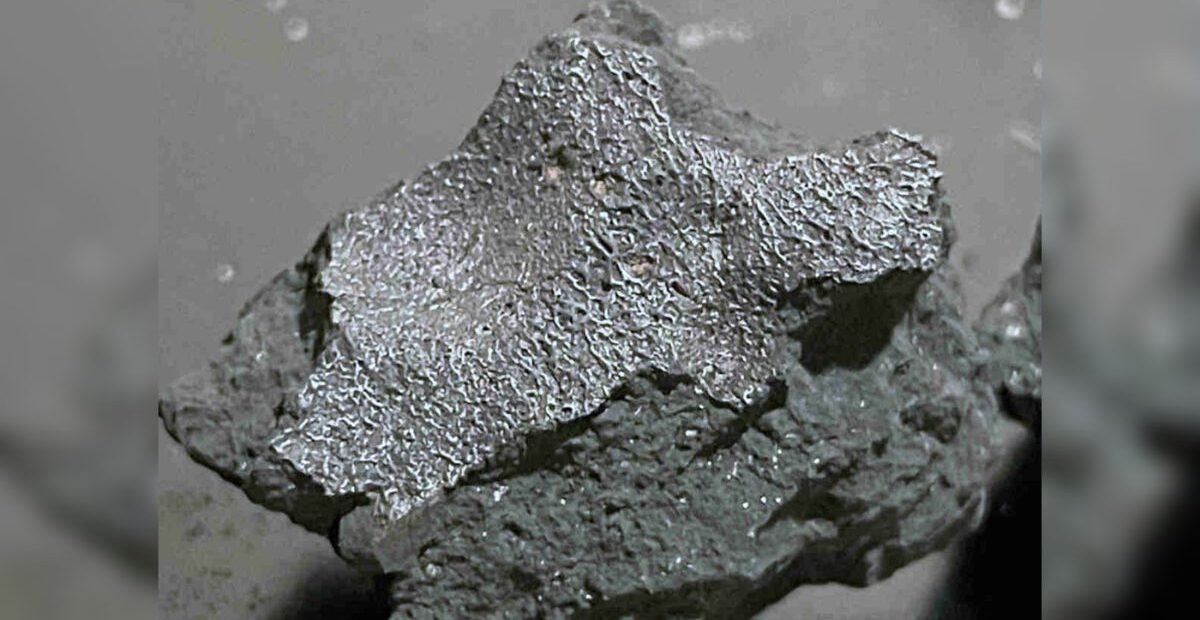
The recovered space rock has been named the Hillsborough meteorite.
An international research team reported its findings in Science Advances, with lead author Peter Jenniskens of the SETI Institute and NASA’s Ames Research Center. The study describes Hillsborough as one of the most scientifically valuable meteorites recovered from an observed fall.
Rare CM1/2 Carbonaceous Chondrite
Scientists classified Hillsborough as a CM1/2 carbonaceous chondrite, a rare intermediate type of primitive meteorite.
CM meteorites formed in the early solar system and are rich in carbon-bearing chemistry. Hillsborough is only the second observed fall of a CM1/2 carbonaceous chondrite, making it especially important for researchers.
Evidence of Water-Altered Asteroid Material
NASA Johnson Space Center meteoriticist Mike Zolensky and other researchers found that the meteorite had been more strongly altered by water than most CM2 meteorites.
That finding suggests its parent asteroid had regions where liquid water once interacted with minerals, changing the rock’s chemistry before it broke away and eventually reached Earth.
Salty Fragments Point to Ancient Brines
Researchers discovered small salt-rich fragments inside the meteorite.
They believe those fragments came from a near-surface area of the parent asteroid where liquid water evaporated and left concentrated salts behind. Scientists say this kind of salty brine environment may have helped drive chemical reactions important to prebiotic chemistry.
Organic Compounds and Amino Acids Found
The Hillsborough meteorite contains a wide range of soluble organic compounds, amino acids and other prebiotic molecules.
Researchers said these findings support the idea that carbon-rich asteroids may have delivered organic material to early Earth. The meteorite’s amino-acid distribution appears to have formed inside the parent asteroid, likely influenced by briny fluid chemistry.
Clues About the Origins of Life
The discovery does not prove that life came from space.
However, it strengthens the idea that meteorites may have delivered important ingredients for life, such as amino acids, carboxylic acids and other organic molecules, to Earth during its early history.
Scientists are especially interested in briny asteroid chemistry because salty fluids can keep phosphate in solution and help catalyze reactions between organics and minerals.
Public Reports Helped Trace the Meteor’s Path
The meteor’s path was reconstructed using public witness reports, video footage and camera data.
Sixty observers across New York, New Jersey, Connecticut, Rhode Island and Pennsylvania reported seeing the meteor to the American Meteor Society, while 16 people in New York and New Jersey reported feeling the shockwave. Cameras in Connecticut, Pennsylvania and New Jersey helped measure the trajectory.
Radar Detected Falling Pebbles
After the meteor faded from view, Doppler weather radar at Newark Airport briefly detected a trail of falling fragments stretching from Staten Island into New Jersey.
Hillsborough sat near the far end of that trail, where the larger pieces were expected to fall. Scientists say only one major fragment was recovered because it struck a house.
Possible Link to the Inner Asteroid Belt
By reconstructing the trajectory, researchers concluded that the meteorite likely came from a low region of the asteroid belt.
The parent object may have originated from a part of the asteroid belt that has been studied by spacecraft missions, giving scientists a valuable chance to connect a recovered meteorite with broader asteroid research.
Fragments Going to Museum Collection
Some of the Hillsborough meteorite fragments will be curated at the American Museum of Natural History in New York City.
Museum curator Denton Ebel said the sample is a precious asteroid specimen delivered directly to scientists’ doorstep.
Scientists Ask Public to Check Cameras After Fireballs
Jenniskens encouraged people who hear about meteorite falls in their area to check dashcams, security cameras, doorbell cameras and phone footage.
Such recordings can help scientists calculate a meteor’s speed, direction and source region, making even accidental footage valuable for space-rock research.
The Hillsborough meteorite is more than a dramatic object that crashed through a New Jersey bedroom ceiling. Its unusually clean recovery allowed scientists to study fragile asteroid chemistry, including salts, organic compounds and amino acids that may help explain how early Earth received life’s chemical ingredients.
With evidence pointing to ancient briny fluids on its parent asteroid, the meteorite offers a rare window into the watery and organic chemistry of the early solar system.