




Wildfire Smoke Blankets Sudbury and Much of the Province: What to Know

Massive wildfires burning across Northern Ontario have sent thick smoke across the province, turning skies orange in several cities and creating dangerous air quality conditions. The fires also disrupted rail operations near Armstrong, where a CN Rail train crew was evacuated after video showed flames surrounding a train on the tracks.
CN Train Surrounded by Flames Near Armstrong
A dramatic video shared by Ontario MPP Sol Mamakwa showed a CN Rail train stopped in a wildfire zone near Armstrong as flames burned around the tracks.
In the video, a crew member can be heard warning that the fire might overtake them and saying the train was surrounded by flames.
CN Says Crew Members Are Safe
CN Rail later confirmed it was aware of the video showing one of its trains in a wildfire-affected area near Armstrong.
The company said the crew members seen in the footage were safe and had been evacuated. CN also said rail operations near Armstrong were temporarily suspended because of ongoing wildfire activity.
Union Says Train Should Not Have Been Sent
The Teamsters Canada Rail Conference, which represents rail workers, criticized the situation and said the train should not have been operating in those conditions.
Union president Paul Boucher said the incident should never have happened and argued that CN knew how dangerous the wildfire conditions were in the region.
Smoke Spreads Across Ontario and Beyond
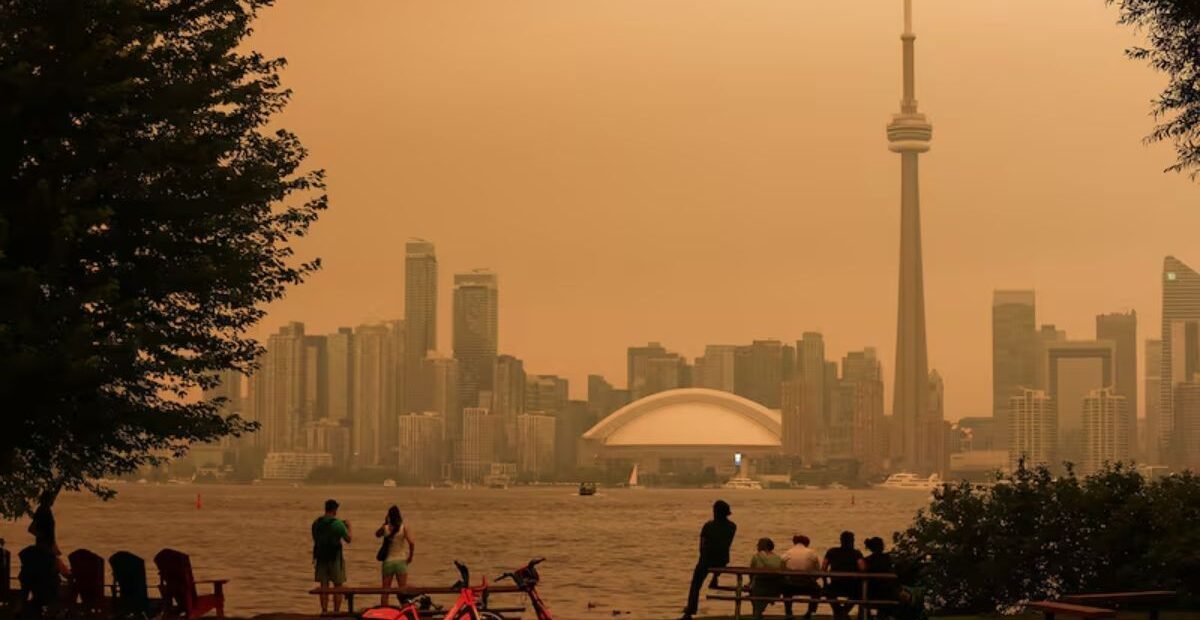
Farther south, residents in Toronto, Montreal, Sudbury and other cities woke up to smoky, orange-tinted skies.
In many areas, the air carried a strong smell of burnt wood as wildfire smoke drifted over communities far from the flames. Reuters reported that smoke from northwestern Ontario also spread toward parts of the northeastern United States, including New York.
Sudbury Under Air Quality Warning
Environment Canada issued an air quality warning for the Greater Sudbury region as wildfire smoke reduced visibility and worsened breathing conditions.
Public Health Sudbury & Districts said the warning covered Greater Sudbury and vicinity, Gogama, Foleyet, Espanola, Massey, Killarney, Manitoulin Island, West Nipissing, French River, Markstay-Warren, St. Charles, Chapleau and Missinaibi Lake.
AQHI Reaches Very High Risk Levels
Canada uses the Air Quality Health Index, or AQHI, to measure health risk from air pollution.
On Wednesday, several Ontario communities were forecast to reach 10+, the highest level on the scale and classified as very high risk. Under those conditions, people are advised to avoid strenuous outdoor activities, especially children, seniors and anyone with heart or lung conditions.
Why the Sky Looks Orange
Experts say the orange or reddish colour comes from smoke particles scattering sunlight.
Greg Evans, a professor of chemical engineering and applied chemistry at the University of Toronto, explained that smoke particles filter out more blue light, allowing more red and orange light to dominate the view.
The effect is similar to sunset colours, except wildfire smoke can make it happen throughout the day.
Toronto Ranked Among Worst Air Quality Cities
Toronto’s air quality deteriorated sharply as smoke moved south.
Reuters reported that IQAir ranked Toronto as having the world’s worst air quality on Wednesday morning, with conditions considered unhealthy, particularly for people with health issues. Toronto’s AQHI was also listed at 10+, meaning very high risk.
How Long Will the Smoke Last?
Air quality conditions can change quickly depending on wind direction, rainfall and wildfire behaviour.
Forecasts suggested Toronto could still see high-risk air quality on Thursday, though shifting winds and rain may bring some relief by Friday. However, as long as fires continue burning in northwestern Ontario, smoke may continue moving into different parts of Canada and the United States.
Wildfires Burning Across Canada
Canada continues to face a significant wildfire season.
Reuters reported that there were 835 active wildfires across the country, including 112 out of control, with about 1.9 million hectares burned so far this season.
Smoke Reaches U.S. Cities
The wildfire smoke is not staying within Canada.
Smoke from Canadian fires has also affected air quality in parts of the U.S. Midwest and Northeast. Washington Post reporting said smoke was expected to spread into the Midwest, Northeast and Mid-Atlantic, potentially affecting around 100 million people through Friday.
What People Should Do During Heavy Smoke
Health experts say the key is reducing exposure.
People should limit time outdoors, avoid intense exercise, keep windows closed when possible and use filtered indoor air if available.
An N95 mask can help reduce smoke-particle exposure outdoors, though it does not make heavy physical activity safe during severe smoke events.
Indoor Air Tips
For people with central air conditioning, experts recommend running the fan continuously if the system has proper filters.
That helps circulate indoor air through the filter. However, people without air conditioning face a difficult choice during combined heat and smoke events: keeping windows closed may reduce smoke exposure, but indoor heat can also become dangerous.
Exercise Should Be Limited
Experts advise against strenuous outdoor exercise during heavy wildfire smoke.
When people exercise, they breathe harder and often through the mouth, allowing more polluted air to reach the lungs. This can increase health risks, especially for children, older adults, pregnant people and those with asthma, heart disease or other health conditions.
Higher Risk Groups Need Extra Caution
People at higher risk should take wildfire smoke warnings seriously.
That includes seniors, young children, pregnant people, people with respiratory or heart conditions, and anyone who works outdoors. When air quality reaches very high risk levels, officials advise reducing or avoiding outdoor activity wherever possible.
Northern Ontario’s wildfires have created a dangerous mix of flames, smoke, transportation disruption and public health risks. A CN Rail crew was safely evacuated near Armstrong after flames surrounded a train, while smoke from the fires spread across Ontario and into the United States.
With Toronto and other cities facing very poor air quality, residents are being urged to limit outdoor exposure, avoid strenuous exercise and monitor official air quality updates until conditions improve.