




PM Carney Says ‘Everything Is on the Table’ in U.S. Trade Talks as Trump Imposes 10% Tariffs on Canada

Prime Minister Mark Carney says Canada is prepared to consider every available response as its trade conflict with the United States intensifies.
Following discussions with provincial and territorial leaders, Carney pledged that the federal government would take the steps needed to protect Canadian families, workers, businesses and industries.
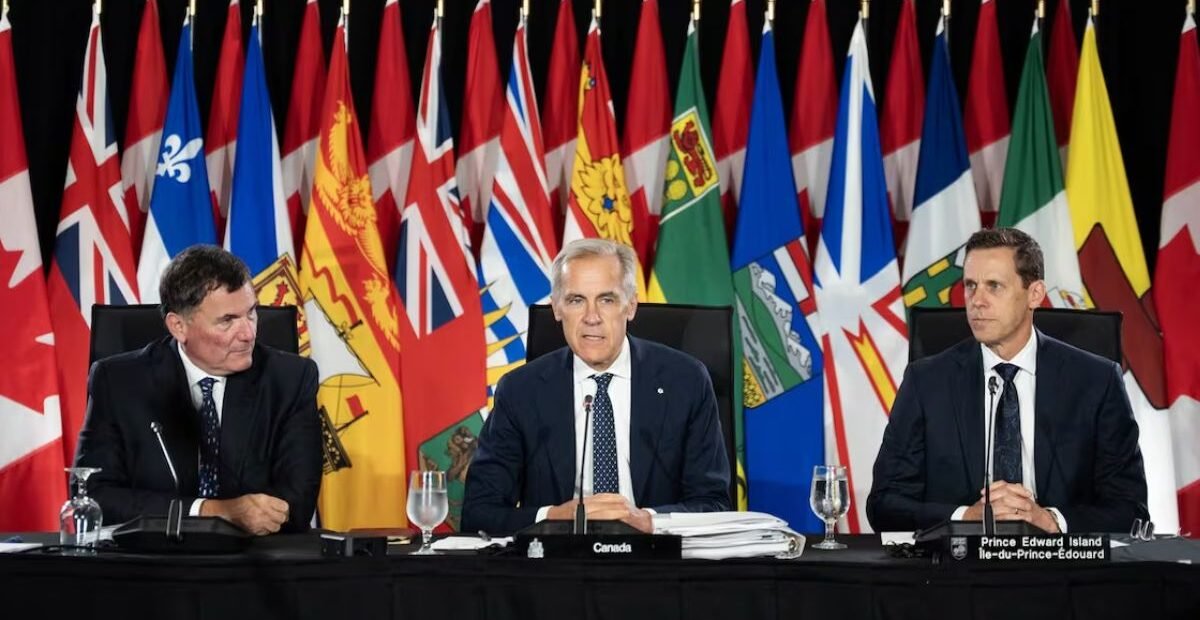
The prime minister made the remarks after meeting Canada’s premiers in Charlottetown, Prince Edward Island. The gathering was dominated by U.S. President Donald Trump’s latest tariff threats and the possibility of additional duties taking effect on August 19, 2026.
Canada Intensifies Trade Negotiations With the United States
Carney said Canada is increasing its negotiating efforts in pursuit of a comprehensive agreement covering all tariff-affected industries.
Although the federal government has not announced immediate retaliatory measures, the prime minister refused to rule them out if negotiations fail.
He emphasized that Canada has several possible responses available but said acting before the tariffs take effect could weaken the country’s negotiating position.
According to Carney, the government’s priority is to understand every option, consult affected provinces and develop a coordinated national response.
He also said federal, provincial and territorial leaders remain united in their overall goals, even when they differ on specific tactics.
“Everything Is on the Table,” Carney Says
After approximately four hours of discussions with the premiers, Carney confirmed that no reasonable option had been excluded from Canada’s negotiating strategy.
The prime minister described the meeting as an example of Canadian federalism functioning effectively. He said national unity would be especially important as Ottawa attempts to negotiate a broader settlement addressing the many trade disputes between Canada and the United States.
Carney also described the 30-day period before the proposed tariffs begin as both a pressure tactic and a genuine opportunity to reach an agreement.
His first priority is strengthening and unifying the Canadian economy, which he said would provide immediate benefits and reduce the country’s vulnerability to external trade pressure.
The second priority is maintaining a consistent negotiating strategy. Carney argued that the dispute should not be treated as several isolated problems because the tariffs affect multiple interconnected sectors.
Trump Announces 50% Tariffs on Selected Canadian Goods
President Trump signed an order imposing a 50% tariff on several Canadian products, including wine, cement, hockey sticks, clothing and certain dairy and wood products.
The tariffs are scheduled to begin on August 19 unless Canada and the United States reach an agreement. Approximately US$20 billion, or C$28 billion, in previously tariff-free Canadian exports could be affected.
Energy products, potash, fish and certain critical minerals were reportedly excluded from this round of duties.
The Trump administration has characterized the measures as a response to Canadian policies affecting American alcohol, automobiles and dairy products. Canadian officials have argued that the tariffs violate the principles of the Canada-United States-Mexico Agreement, commonly known as CUSMA.
Canada Included in New Forced-Labour Tariffs
The Trump administration has also announced additional tariffs against more than 60 countries over concerns about forced labour in international supply chains.
Canada, Mexico and the United Kingdom face a 10% duty, while several other economies are subject to a 12.5% tariff. The U.S. Trade Representative said the lower rate applies to countries with forced-labour import restrictions or commitments to introduce and enforce them.
The treatment of products meeting CUSMA requirements has remained an important issue during negotiations. Reports indicated that qualifying products could remain protected, but Canadian officials and business groups have requested clear confirmation.
Canada and U.S. Share Forced-Labour Objective
Canada-U.S. Trade Minister Dominic LeBlanc said Canada supports the American objective of preventing goods made with forced labour from entering North American supply chains.
However, he defended Canada’s existing system, describing it as a strong framework supported by legislation and enforcement measures.
LeBlanc also highlighted legislation introduced by the federal government in June to strengthen Canada’s restrictions on forced-labour imports. Ottawa intends to continue discussions with Washington on the tariffs and other unresolved trade matters.
Proposed Canadian Law Would Strengthen Import Controls
The federal legislation, titled An Act Respecting the Prohibition of the Importation of Goods Produced by Forced Labour, would provide authorities with additional tools to identify and block high-risk imports.
Under the proposed law, the foreign affairs minister could create a list of goods considered vulnerable to forced-labour practices. Products could be classified according to their region of origin, the companies involved or specific entities connected to their production.
Importers handling high-risk goods would be required to provide greater supply-chain transparency to customs authorities. Products could be refused entry into Canada when importers fail to meet the requirements.
The federal government says stronger enforcement would protect human rights while preventing businesses using exploited labour from gaining an unfair advantage over Canadian companies and workers.
Canadian Chamber Calls Broad Tariff Misguided
The Canadian Chamber of Commerce argued that Canada should not have been included in the forced-labour tariffs.
Matthew Holmes, the Chamber’s executive vice-president and chief of public policy, pointed to Canada’s existing ban on forced-labour goods, planned legislative reforms and private-sector investments in compliance and supply-chain transparency.
The Chamber recommended that the U.S. Trade Representative:
- Recognize Canada’s new forced-labour reforms.
- Target goods and industries with a demonstrated high risk.
- Avoid applying a general 10% tariff to Canadian products.
- Strengthen joint Canada-U.S. enforcement.
- Clearly explain whether CUSMA-compliant goods are exempt.
The organization is also working with Ottawa as Bill C-35 progresses through Parliament.
U.S. Politicians Support Stronger Enforcement
The U.S. Trade Representative cited bipartisan statements from American lawmakers condemning forced labour and demanding more effective enforcement.
Democratic and Republican politicians have supported measures intended to stop illicit, counterfeit and forced-labour products from entering the United States.
However, the politicians highlighted by the trade office generally called for stronger inspections and enforcement rather than broad tariffs.
U.S. representatives including Maxine Waters, Ilhan Omar, Linda Sánchez, Chris Smith, Nancy Pelosi, Jim McGovern and Nathaniel Moran have publicly condemned forced labour or called for greater supply-chain accountability.
American Small Businesses Question Tariff Rationale
We Pay the Tariffs, a coalition representing approximately 1,200 American small businesses, criticized the administration’s approach.
The organization argued that duties on products such as Australian wine and Swiss cheese would do little to address forced-labour concerns in countries where serious abuses may occur.
The Trump administration maintains that its Section 301 investigations have already encouraged some trading partners to strengthen their forced-labour import restrictions.
The U.S. trade office nevertheless concluded that Canada had not effectively enforced its existing prohibition.
Premiers Support National Unity but Differ on Tactics
Canada’s premiers broadly support a united national strategy, but they have proposed different ways of responding.
Ontario Premier Doug Ford called for a forceful response if the United States proceeds with the tariffs. He argued that Canada must protect its jobs, businesses and economy rather than constantly reacting defensively.
Ford also described the tariffs as a tax on American consumers and said the uncertainty was discouraging investment on both sides of the border.
He believes concern is growing among both Democratic and Republican officials, governors and businesses in the United States as companies seek greater economic stability.
Ontario may face particularly serious consequences because of its extensive manufacturing and trading relationship with the American market.
Alberta Rejects Using Oil as a Trade Weapon
Alberta Premier Danielle Smith warned against using Canadian oil exports as leverage.
She said Alberta’s strategy of speaking directly with American businesses and consumers has helped demonstrate the importance of reliable cross-border energy flows. Canadian energy helps limit fuel shortages and control prices for American consumers, businesses and transportation industries.
Heather Exner-Pirot of the Macdonald-Laurier Institute also urged caution. She said the two countries are highly dependent on one another’s oil industries and noted that energy remains one of Canada’s largest sources of exports, foreign exchange, employment and government revenue.
Smith nevertheless expressed confidence in Carney’s broader negotiating approach.
British Columbia Businesses Could Receive Federal Support
British Columbia Premier David Eby said tariff-affected companies in his province could qualify for assistance through a federal regional emergency fund worth approximately $1.5 billion.
According to Eby, Carney indicated that the fund had not been exhausted and should contain sufficient resources if the proposed tariffs begin on August 19.
Eby warned that businesses were already suffering because uncertainty makes planning, investment and expansion more difficult.
Provinces Keep American Alcohol Off Shelves
Eby said British Columbia and several other provinces and territories have no immediate intention of returning American liquor to government-controlled shelves.
He described the restrictions as an important source of leverage in negotiations with Washington.
The removal of American alcohol has become one of the most visible provincial responses to the trade conflict and one of the grievances cited by the Trump administration.
Premiers Push to Remove Internal Trade Barriers
Prince Edward Island Premier Rob Lantz said Canadian leaders are also working to reduce barriers that make it difficult to trade goods and services between provinces.
Premiers recently signed a memorandum intended to remove major restrictions on interprovincial alcohol sales. However, barriers involving dairy products, construction materials, food and other supply-managed goods remain.
Lantz argued that trading between Canadian provinces should not be more complicated than trading internationally.
Carney said the Internal Trade Committee would seek an agreement-in-principle during the summer to improve labour mobility. No firm deadline was announced for eliminating all remaining internal trade barriers.
Premiers Link Economic Strength With Public Services
The first ministers also discussed health care, infrastructure and domestic economic resilience.
Manitoba Premier Wab Kinew said maintaining universal access to a functioning health-care system is an essential part of building a strong and independent country.
Nova Scotia Premier Tim Houston similarly argued that healthy populations create healthier economies.
New Brunswick Premier Susan Holt said Canada could use regional energy connections and exports to strengthen the national economy.
Saskatchewan Premier Scott Moe expressed cautious optimism that intensified talks could produce a renewed CUSMA agreement. Smith also said Canada has a limited window to sharpen its objectives and focus its negotiating strategy.
Canada Must Prepare for Negotiations to Fail
Canada-U.S. Trade Relations Council member Ralph Goodale said premiers may favour different tactics, but they remain united around the central goal of defending the Canadian economy.
He argued that Canada should use the period before the tariffs begin to make the strongest possible case for an agreement.
Goodale also warned that weakening CUSMA would damage American interests as well as Canadian ones. Canada must therefore continue negotiating while preparing for the possibility that no agreement will be reached.
Political analysts have reported growing unease among U.S. lawmakers, including some Republicans, over the unpredictable nature of the administration’s trade measures.
Electronics Industry Faces Significant Exposure
Canada’s electrical and electronics sector could be among the industries most affected.
Electro-Federation Canada estimates that approximately 90% of Canadian electronics exports are sold to the United States.
Because electrical and automation supply chains have been integrated since the introduction of NAFTA, tariffs could disrupt production in both countries.
The industry has requested incentives supporting Canadian manufacturing, domestic-content requirements and continued investment tax credits. Representatives have also warned that trade restrictions could slow electrification projects and efforts to reduce carbon emissions.
Pharmaceutical Supply Chains Could Be Disrupted
The Canadian Generic Pharmaceutical Association warned that medicine supply chains in Canada and the United States are deeply interconnected.
Canada purchases U.S.-manufactured generic medicines, including products used in hospitals. Canadian manufacturers also rely on American-made active pharmaceutical ingredients, packaging materials, excipients and other essential inputs.
Industry representatives warned that tariffs could disrupt already fragile supply chains, increase costs and threaten the reliable availability of medicines in both countries.
Exporters Prepare for a Possible Shipping Rush
Trade specialists described the current period as a possible “storm before the calm,” noting similarities with earlier tariff announcements.
Many importers and exporters are currently taking a wait-and-see approach. However, companies could rush to move products across the border shortly before the August 19 deadline if an agreement appears unlikely.
Businesses would have a strong incentive to accelerate shipments because affected products could face a 50% charge once the tariffs take effect.
Some analysts believe economic weakness, inflation concerns and the approaching U.S. midterm election cycle may increase pressure on Washington to resolve the dispute.
Manufacturers Warn of Reduced Investment
Canadian Manufacturers & Exporters estimates that the proposed tariffs could affect approximately US$20 billion, or C$28 billion, in goods that had previously entered the United States tariff-free.
President and CEO Dennis Darby said companies that had largely escaped previous tariffs are now expressing serious concern.
Prolonged uncertainty surrounding CUSMA has already caused some businesses to delay purchasing equipment, expanding factories or investing in additional production.
According to the organization, 73% of its members believe failure to renew CUSMA would reduce their confidence and weaken expectations for future growth.
Carney Clarifies Gordie Howe Bridge Agreement
Carney also addressed confusion surrounding the Gordie Howe International Bridge agreement.
He acknowledged that he should have explained the arrangement more clearly after previously suggesting that revenue would be shared with the United States only after Canada recovered its debt-related costs.
Published details indicated that Canada would share part of the bridge’s net revenue with the United States during the first 15 years, after operating and certain other expenses, but without first deducting debt repayment.
The prime minister said his earlier comments had referred to a separate underlying agreement involving the repayment structure.
Canada is entering a critical period in its economic relationship with the United States. Prime Minister Mark Carney is prioritizing negotiations while preparing possible support programs and retaliatory measures if the proposed tariffs proceed.
Although premiers disagree about tactics such as oil restrictions or aggressive counter-tariffs, they continue to support a coordinated Team Canada strategy. The outcome of the negotiations will affect manufacturers, exporters, energy producers, pharmaceutical companies and consumers on both sides of the border.
Canada’s immediate challenge is to protect affected industries without weakening its negotiating position. Its longer-term objective will be strengthening internal trade, diversifying export markets and reducing dependence on unpredictable U.S. trade policies.